Jungfraujoch Facts: 12 Things Most Visitors Miss
The short answer. The railway to the Jungfraujoch was sketched in a hotel room in 1893, dug by hand for 16 years, and meant to reach the summit of the Jungfrau, not the col. Its ice halls were cut by mountain guides with saws, its observatory helped find a new particle, and at the top you lose a glass of water an hour just by breathing.
The Jungfraujoch is easy to visit and easy to misread. The station, the ice halls and the observatory each carry a story you will not hear on the train unless someone tells you. These are the facts that change how the day looks, most of them from Jungfrau Railways' own history of the line.
1. The whole railway was decided on a Sunday walk
On Sunday, 27 August 1893, the Swiss industrialist Adolf Guyer-Zeller was hiking above Mürren with his daughter when he watched a train climb the brand-new line to Kleine Scheidegg. That night, in room 42 of the Mürren spa hotel, he sketched the Jungfrau Railway on a sheet of paper. Within four months he had applied for the licence.
2. It was meant to reach the summit of the Jungfrau
Guyer-Zeller's plan ended at the top of the Jungfrau itself, 4,158 metres high, with a lift of just 100 metres for the last stretch. After his death in 1899, money ran short and the builders stopped at the Jungfraujoch, the saddle between the Mönch and the Jungfrau. The "Top of Europe" is the compromise. The mountain's own name has a quieter origin: Jungfrau means "virgin", and it most likely comes from Jungfrauenberg, the old name of the Wengernalp pastures, which belonged to the nuns of Interlaken's monastery.
3. It took 16 years, and it was dug by hand
Work began on 27 July 1896 and the tunnel broke through on 21 February 1912. The first workers, mostly from Italy, had no machines: shovels, picks and their own strength. To supply the construction colony in winter, a team of huskies was kept on the glacier. The first section, to the Eiger glacier, opened in September 1898, and Guyer-Zeller invited 450 wealthy guests to the ceremony. It was a sales pitch: within 18 months, 4,000 shares had been subscribed.
4. Thirty workers died, and they are remembered at the top
The workers went on strike six times, the construction management changed eight times, and 30 men lost their lives, most of them in blasting accidents. Alpine Sensation, the corridor you walk through at the top, carries 30 memorial tablets for them.
5. For seven years the end of the line was a hotel in the ice
From 25 July 1905 the railway stopped at Eismeer, 3,160 metres up inside the Eiger, while the last section was dug. The station had a waiting room, a restaurant and bedrooms for tourists. A short flight of stairs led out onto the crevassed Grindelwald-Fiescher glacier, and touring skiers still start the Eismeer runs down to Grindelwald from here. Some trains pause at the station for five minutes today, when they can.
6. Mountain guides carved the Ice Palace with saws
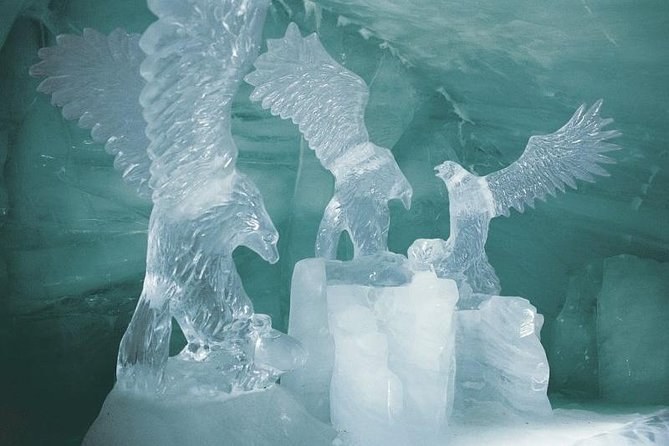
The halls of the Ice Palace were cut into the Jungfraufirn glacier in the 1930s by mountain guides, using picks and saws. The eagle, penguin and bear in its niches are the work of artists who renew them today.
7. The observatory helped discover a particle
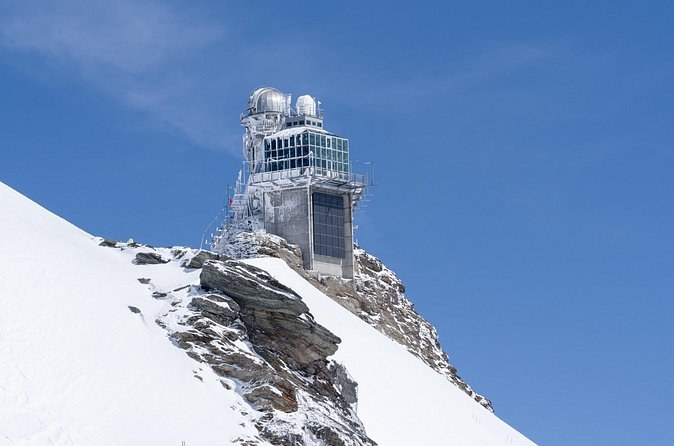
A research station opened at the Jungfraujoch in 1931 and the Sphinx Observatory in 1937. In 1949, photographic plates left out to catch cosmic rays at the observatory gave the first precise evidence for the charged K-meson, a subatomic particle.
8. The Sphinx is in a different canton from the train
You arrive from the Bernese Oberland, but the Sphinx building stands on the Valais side of the border, a few metres from the canton of Bern. Its lift climbs 108 metres in 25 seconds.
9. You lose a glass of water an hour by breathing
At this altitude each person loses around 200 ml of fluid an hour through breathing out, which is why Jungfrau Railways tells visitors to drink plenty of water. It is also why the railway advises against the trip for children under 2.
10. There is an Indian restaurant on the glacier
Among the restaurants at 3,454 metres is Bollywood, an Indian self-service restaurant. Next door, the Lindt shop is the highest in the world.
11. Summer barely crosses zero
On MeteoSwiss's 1991-2020 averages for the station, the warmest month, August, has a mean of 0.6 °C, and February averages −13.3 °C. Jungfrau Railways says that in the hottest months the temperature regularly rises above zero, and the Plateau still has snow and ice 365 days a year. That is why the Snow Fun Park can run its zipline and sledging on the glacier from late April to mid-October.
12. One June day, more than 8,000 people went up
The railway's busiest day on record was 1 June 2000, with 8,148 visitors. If you want the terrace without the crowd, the first trains of the morning are the ones to catch, and how to visit the Jungfraujoch explains the early fare.
Why the facts matter on the day
| Fact | What it means for your visit |
|---|---|
| The station is inside the rock | Much of the circuit is indoors, so a cloudy day still works |
| The Sphinx is higher | Go up first if the sky is clear |
| Fluid loss at altitude | Carry water and drink it |
| Snow all year | Dress for winter in July |
| Eismeer stop not guaranteed | Do not plan the day around it |
Most of these stories are told on the way up by a guide, which is what a guided day from Lucerne or a guided day from Zurich gives you. Going alone, read up first: the summit level by level walks you round, and the routes page explains the stations inside the Eiger.
Where these facts come from
- Jungfrau Railways: the construction of the Jungfrau Railway
- Jungfrau Railways: the Ice Palace
- Jungfrau Railways: Alpine Sensation
- Jungfrau Railways: the Sphinx Observation Deck
- Jungfrau Railways: Eismeer station
- Jungfrau Railways: the Eiger Express
- Jungfrau Railways: restaurants at the Jungfraujoch
- Jungfrau Railways: Lindt Swiss Chocolate Heaven
- Jungfrau Railways: frequently asked questions (fares, children, seat reservations, medical advice, accessibility)
- Jungfrau Railways: the Snow Fun Park
- MeteoSwiss: homogeneous monthly series, station Jungfraujoch (JUN)
- Wikipedia: Jungfrau Railway
- Wikipedia: Jungfraujoch
- Wikipedia: Sphinx Observatory
Days where a guide tells the story
Jungfraujoch & Lauterbrunnen Alpine Tour | From Bern
A small group of up to 15 by public train from Bern station, with about 3 hours at the top.
From $650 per person
Check Availability
Jungfraujoch Top of Europe Day Trip from Lucerne
From central Lucerne: up by cogwheel, down by gondola, and about 3 hours at the top with the guide.
From $344 per person
Check Availability
Jungfraujoch Top of Europe Private Day Trip from Interlaken
Hotel pickup in Interlaken and your own guide, with about 3 hours at the Jungfraujoch.
From $937 per person
Check AvailabilityNext: take the family up with the Jungfraujoch with kids. Every guided day, private day and railway ticket to the top sits side by side on Jungfraujoch Tours.